
responsible production

BEHIND THE SCENES, SUSTAINABILITY, ZERO WASTE

the administrative border: navigating updated EU packaging rules from a UK studio

earlier this year, the european union rolled out updated enforcement guidelines around extended producer responsibility (EPR) alongside the overarching framework of the EU packaging and packaging waste regulation (PPWR). for independent UK design studios shipping physical goods into EU member states, these updates have transformed what used to be a simple postal transaction into a complex compliance exercise.

to understand why so many independent UK studios are currently pausing direct-to-consumer EU shipping, it helps to examine the structural mechanics behind these directives.

what is extended producer responsibility (EPR)?

EPR is an environmental policy approach under which producers are held financially and operationally responsible for the post-consumer stage of a product’s packaging lifecycle. in straightforward terms: if you send packaging into a country, you are expected to pay for its recycling and collection.

under pre-Brexit single-market rules, cross-border compliance was largely harmonised and friction-free for UK businesses. post-Brexit, however, the UK is classified as a "third country." this status means UK exporters must comply with the individual third-country environmental regulations of all 27 EU member states independently.

the core administrative hurdles for UK exporters

  1. decentralised registration systems

    there is no single, centralised EU portal for EPR packaging compliance. for example, germany operates through its LUCID packaging register; france enforces rules via ADEME and CITEO; spain, italy, and the netherlands each maintain their own national registers and administrative bodies. to legally send a boxed cushion or lampshade to a retail customer in germany or france, a UK studio must register with each respective national authority, pay annual platform fees, and submit detailed reports tracking the exact weight of paper, cardboard, and plastic exported into that specific territory.

  2. authorised representatives and national fees

    several EU member states now require non-EU sellers to appoint a legally recognised in-country "authorised representative" to handle their environmental reporting, for each country. for a high-volume manufacturer, these annual compliance retainer fees are minor operational overheads. for an independent studio hand-printing short-run textiles, the annual administrative costs quickly exceed the profit margins of small B2C orders. we do work with a hungarian consulting company to work as a data representative for GDPR and as our product safety representative for GPSR. but for a small studio such as ours would struggle to find a recycling representative in each country.

  3. standardised sorting and material labelling

    the EU framework mandates explicit recycling instructions on packaging materials, most notably france’s mandatory triman logo and sorting information. sending unlabelled cardboard boxes or non-compliant tape across borders exposes parcels to customs delays, administrative fines, or direct returns at the border.

why zitozza is pausing direct EU retail checkout

at zitozza, our modular pattern logic is rooted in efficiency, structural geometry, and material honesty. spending hours navigating 27 distinct administrative portals to ship a single printed item simply does not align with a streamlined studio practice.

we are currently undertaking a complete operational and studio audit. while we review the most efficient compliance frameworks for international parcel logistics, direct B2C website checkout to EU addresses is temporarily paused.

the B2B specifier pathway

our understanding is that these rules only apply to individual retail web orders, and that our trade pipeline for commercial interior projects, architects, hospitality specifiers, and interior designers across the EU can remain fully operational (with all goods shipped under DAP terms).

so, the good news is for project-based specifications (such as custom linear meterage, bespoke spatial runners, or large-scale architectural installations) logistics and customs clearances are processed directly via established commercial freight invoicing and trade channels.

if you are an EU-based specifier working on a bespoke residential or commercial space, drop us a line directly through our contact page to request swatch swatches, technical material specifications, or custom layout configurations.

for retail orders we will be in touch as soon as the rules change. we are also open to stockists and representatives in the EU who would be willing to place B2B orders from us and sell to EU retail clients - just get in touch.

JUTE, TEXTILE INDUSTRY, SUSTAINABILITY, ZERO WASTE

10 reasons why jute is one of the most sustainable textile in the world (including one huge potentiaL)

i have always wanted to write about this, because it is one of the main reasons i got interested in jute at all - apart from the amazing aesthetics, that sort of fibrous, raw, utilitarian, functional, “textile brute” appeal (which is worth another blog post at some other time). but right now, it’s time to talk sustainability because the textile industry is one of the worst offenders in the world when it comes to pollution and the responsibility is ours, designers, to find alternatives that are friendlier to our environment. jute is an amazing choice for this use too, and below i listed the main reasons of its sustainability benefits.

jute-plant-growing.jpeg

1. SMALL WATER FOOTPRINT

the jute plant grows in the tropical regions, in countries such as india, bangladesh, pakistan, thailand and southern china and it is also cultivated in many south american countries. it relies on natural rainfall, reducing the need of complicated irrigation systems and require fewer freshwater sources.

2. SMALL LAND FOOTPRINT

the jute plants grow very densely to each-other and crops are produced very efficiently, a decent crop can be cultivated on a smaller piece of land that doesn’t take a lot of space away from natural habitats or other agriculture.

3. REDUCED NEED FOR CHEMICALS

this density by which it grows leaves little space for weeds or other pests, and as such, it’s grown without a huge amount of pesticides. they also don’t need a huge amount of fertilisers either (typically less than 20 kg per hectare is applied)

4. SOIL HEALTH

growing jute plant leaves the soil with more nutrients than before the process. this is because their leaves drop often, creating organic matter that is feeding the soil with nutrients. growing jute can be used in poor quality soils to regenerate waste lands and help with food agriculture in some of the most impoverished regions in the world.

5. CARBON CAPTURE

the jute plant binds carbon dioxide faster than trees and it’s good at releasing oxygen (one hectare of jute plants can consume about 15 tons of CO2 from atmosphere and release about 11 tons of oxygen in the 100 days of the jute-growing season)

6. fast growth

jute plants reach growth in 4-6 months, meaning crops can be harvested a few times a year, this is not only highly economical, but also a sustainable pace and more in line with demand.

7. recyclable and biodegradable

while some of the jute plant is not used at the moment, all production waste is recycled and all of it is biodegradable in its natural form.

8. under-utilised potential for the paper industry

the inside fibres of the jute plants (jute sticks) are still considered waste and are recycled, however, research is ongoing into using it for paper production. it could potentially supply the paper industry with pulp, reducing the need for cutting down trees.

9. production

jute is a utilitarian, industrial fabric, usually woven to lower quality standards requiring less energy-heavy processing and a reduced amount of chemicals. most of the industry uses it in its natural, unbleached form.

10. long life-cycle

jute is a strong and durable fibre, often used for ropes, rugs, heavy duty bags and tarpaulins. it has a long life-cycle before it breaks down (and when it does, it is fully biodegradable and recyclable)

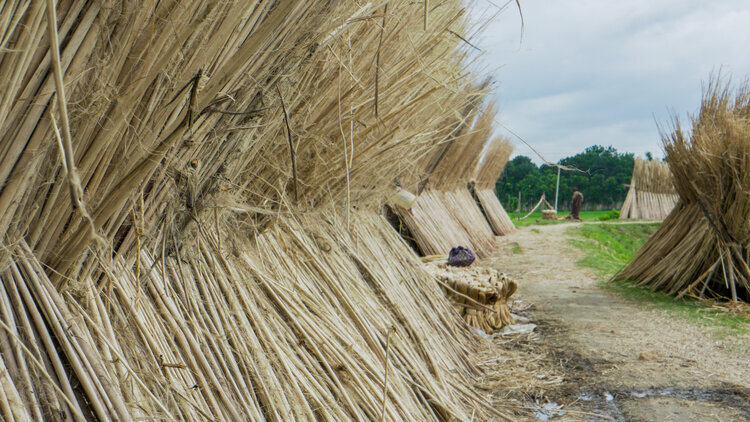
jute-plant-processing-drying.jpeg

it is clear that jute is a wonderfabric which, if we could accept it being used more widely, could help our living situation on this planet. having said all of that, it is also important that we don’t brush over the inconvenient truths as well - jute is a hard fibre, and to soften it enough to make it spinnable, the industry killed a lot of whales for its oil in the last centuries. this is now replaced with other oils such as paraffin and palm oil which bear their own negative effects, however the industry is continuously working on reducing the necessary amounts of these materials. there is also research that the retting process (also used in flax and hemp production) can also be damaging to aquatic life which is yet to be resolved - unfortunately the textile industry remains an environmentally impactful one.

all in all though, when compared with other materials, jute comes out as one of the best ones. (according to the higgs index of sustainability and impact, natural jute has an overall score of 40, while, for instance, dyed cotton has an impact score 101. jute's water scarcity impact is 10 times less of cotton products.) when it comes to the responsibility of the textile industry, it is absolutely imperative that we use materials that cause the least possible harm to our living environment.

for me, jute and its industrial, raw, functional nature brings also an immense aesthetic value that fits into my design values - i think great parallels can be drawn with the raw concrete as the preferred external material and the functional architecture that is a great source of inspiration of the designs themselves - perhaps it’s worth expanding on that in another blogpost. nevertheless, i hope that in the future, we will see more and more of jute coming into the cosy, warm homes, bringing us the tactile comfort and the environmental benefits - for a more content home, inside and in the wider world too.

-

links:

the sustainable fashion collective

better meets reality

down to earth

the higg index

images: adobe stock photos